

Hyundai i10 (2013 to 2019) MPG and fuel consumption
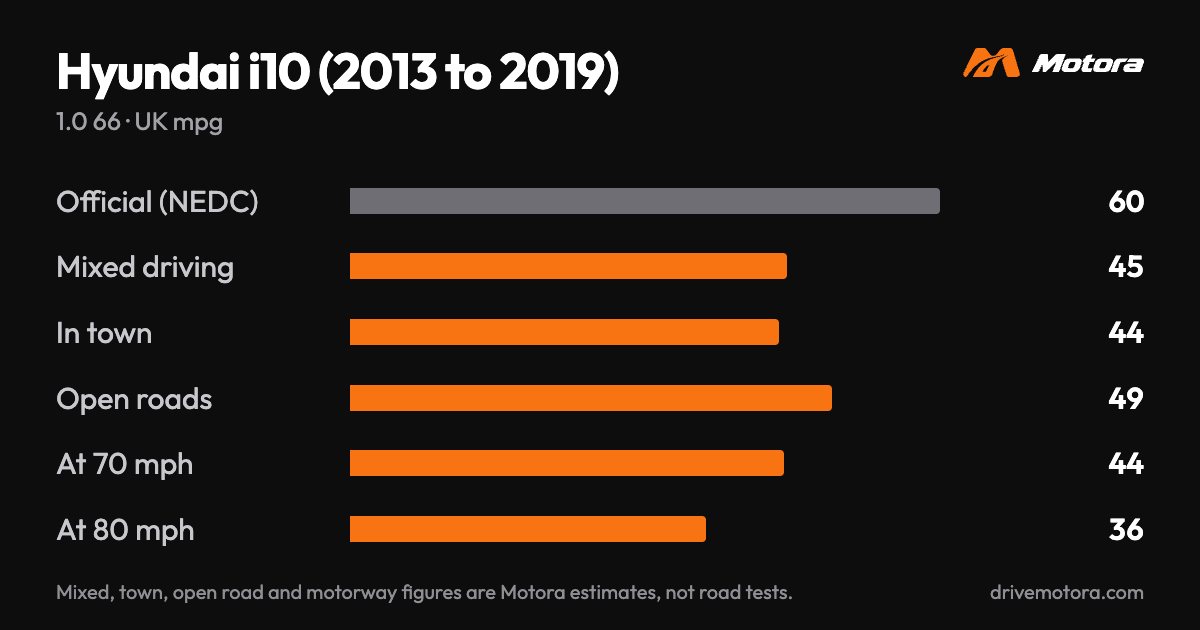
The Hyundai i10 (2013 to 2019) officially does 48 to 67 mpg depending on the engine (4.2 to 5.9 L/100 km). The most economical is the 1.0 Blue 66 at 67.3 mpg. Expect about 44 mpg in town and 44 mpg at a steady 70 mph from the 1.0 66 engine.
2013 to 2019
At a glance
Every engine
The official combined figure for each engine, with our real-world estimates for town and a steady 70 mph.
| Engine | Years | Power | UK mpg | US mpg | L/100 km | Town | 70 mph |
|---|---|---|---|---|---|---|---|
| 1.0 Blue 66 | 2014-2019 | 66 hp | 67.3 | 56 | 4.2 | 48 | 50 |
| 1.0 66 | 2013-2019 | 66 hp | 60.1 | 50 | 4.7 | 44 | 44 |
| 1.25 87 | 2013-2019 | 86 hp | 57.6 | 48 | 4.9 | 41 | 45 |
| 1.25 87 automatic | 2013-2019 | 86 hp | 47.9 | 39.9 | 5.9 | 35 | 37 |
These engines were tested on NEDC, which is well known for being optimistic, so real driving usually lands well below the figure.
What it costs to run
Fuel only, for the 1.0 66 engine in mixed real-world driving, at average UK prices of 158.1p a litre.
| 5,000 miles a year | £807 |
| 8,000 miles a year | £1,291 |
| 12,000 miles a year | £1,936 |
| Per mile | £0.16 |
| 100 motorway miles at 70 mph | £16.25 |
| The same 100 miles at 80 mph | £19.82 |
Which engine is cheapest to run
At 8,000 miles a year, the 1.0 Blue 66 costs about £419 a year less in fuel than the 1.25 87 automatic.
| 1.0 Blue 66 | £1,151 |
| 1.0 66 | £1,291 |
| 1.25 87 | £1,302 |
| 1.25 87 automatic | £1,570 |
Against cars with similar power
In mixed real-world driving, the 1.0 66 engine ranks 15 of the 53 petrol, diesel and hybrid cars we cover with 53 to 82 hp, at 45 mpg against an average of 41 mpg. That puts it better than average.
Closest cars with similar power that use less: Skoda Citigo (2012 to 2019) (46 mpg), Kia Picanto JA (facelift) (46 mpg), Peugeot 208 P21 (46 mpg).
Compares each model’s everyday engine using our estimates, so close positions are very similar.
Where the fuel goes
On a typical mixed drive in the 1.0 66 engine. Air resistance is the biggest share, so speed and roof loads matter most.
Town, open road or motorway
There’s little between town and motorway for the 1.0 66 engine: about 44 mpg in town and 44 mpg at 70 mph. Open roads at moderate speed are its best case, at about 49 mpg.
What changes your mpg
Three habits, worked out for the 1.0 66 engine.
The official figure says 60 mpg. What does yours really get?
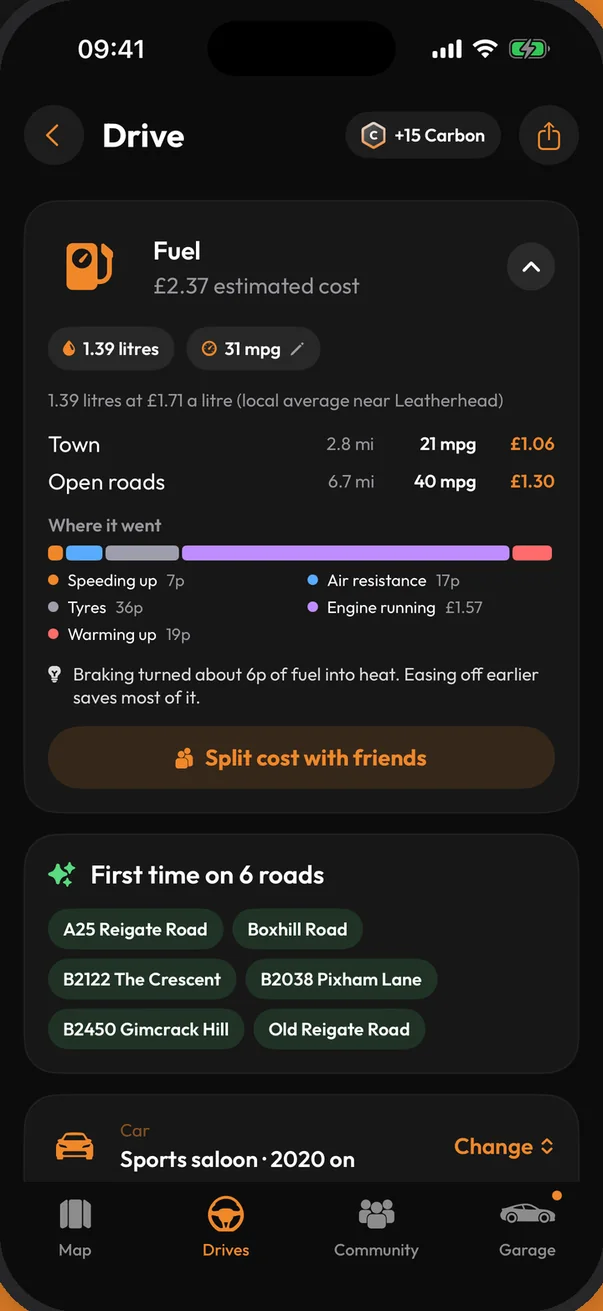
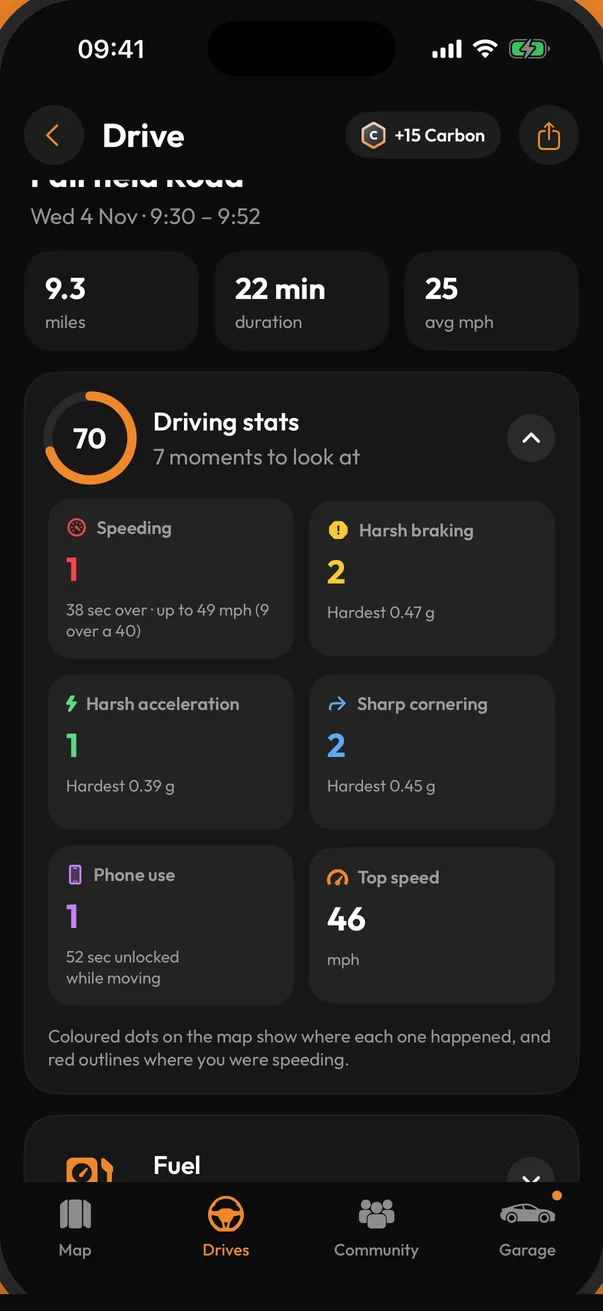
Motora records every drive on its own and scores how you drove, with harsh braking, hard acceleration, sharp corners and phone use pinned on the route.
With Motora Club it also works out what each drive cost for your exact engine, using pump prices near you, and shows your real economy against the official figure. Then build your car in a 3D garage.
Questions
What mpg does the Hyundai i10 (2013 to 2019) get?
The Hyundai i10 (2013 to 2019) officially does 48 to 67 mpg depending on the engine (4.2 to 5.9 L/100 km). The most economical is the 1.0 Blue 66 at 67.3 mpg. Expect about 44 mpg in town and 44 mpg at a steady 70 mph from the 1.0 66 engine.
Which Hyundai i10 (2013 to 2019) is the most economical?
The 1.0 Blue 66, officially 67.3 mpg. The least efficient is the 1.25 87 automatic at 47.9 mpg.
Is the Hyundai i10 (2013 to 2019) better in town or on the motorway?
There’s little between town and motorway for the 1.0 66 engine: about 44 mpg in town and 44 mpg at 70 mph. Open roads at moderate speed are its best case, at about 49 mpg.
How much does 80 mph cost over 70 in the Hyundai i10 (2013 to 2019)?
For the 1.0 66 engine, about 22% more fuel over the same distance, on our model.
How much does the Hyundai i10 (2013 to 2019) cost to run in fuel?
About £1,291 a year for the 1.0 66 engine at 8,000 miles, in mixed driving, at average pump prices.
Is the Hyundai i10 (2013 to 2019) good on fuel?
For its power, the 1.0 66 engine is better than average: 45 mpg in mixed driving on our estimates, against an average of 41 mpg across the 53 petrol, diesel and hybrid cars we cover with 53 to 82 hp.
More fuel economy pages
Official figures are combined test results and can differ a little between markets. Town, road and motorway figures are Motora’s estimates from a physics model calibrated to each official figure, not measurements of a particular car. Motora isn’t affiliated with or endorsed by Hyundai. How we work this out. Figures last updated 24 November 2026.